For many businesses, expired products are viewed as a dead end. Once inventory reaches its expiry date, the focus often shifts to disposal as quickly as possible.
But in today’s sustainability-driven business environment, expired products should not be seen simply as waste. They should be viewed as part of a broader resource recovery opportunity.
Across retail, manufacturing, hospitality, healthcare, and distribution sectors, expired inventory can occupy valuable storage space, increase disposal costs, and create operational inefficiencies. Yet many of these products contain materials that can still be recovered through structured recycling and waste management processes.
The key lies in understanding that expiry does not necessarily mean the end of value.
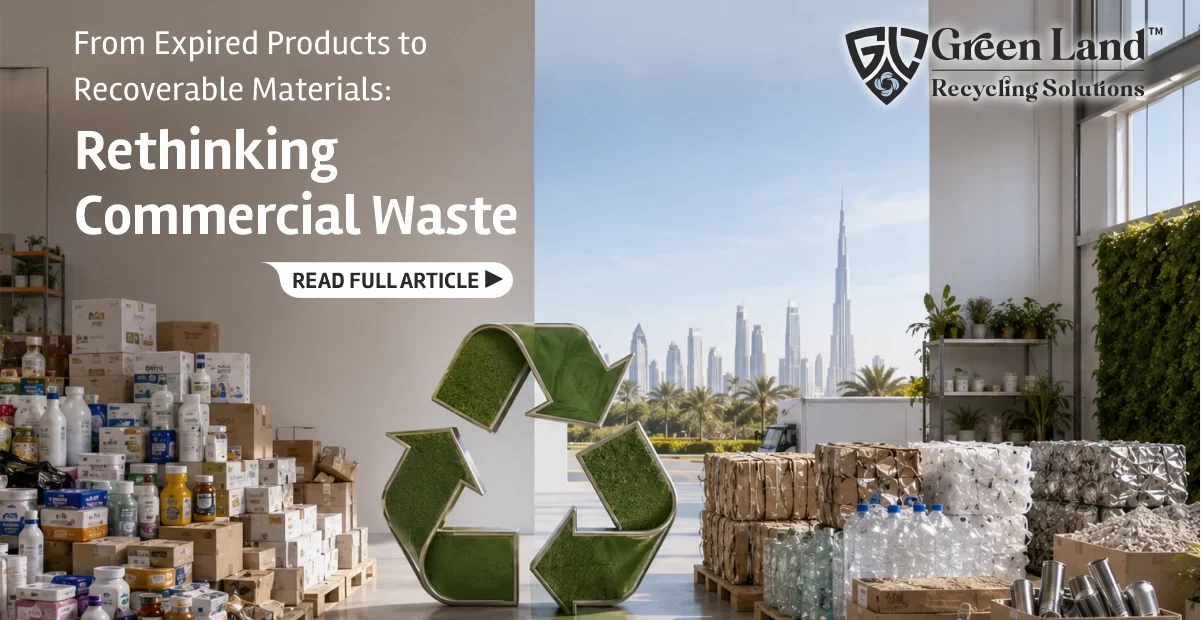
Many expired products consist of multiple components, including cardboard packaging, plastics, metals, paper, and organic materials. When these items are properly segregated, significant portions can be diverted from landfill and directed into appropriate recycling streams.
Without segregation, however, recoverable materials are often mixed with general waste, reducing recycling potential and increasing disposal costs. This is why effective waste segregation remains one of the most important steps in responsible commercial waste management.
At Green Land Recycling Solutions, businesses are supported with structured approaches to handling expired stock, bulk waste, recyclable materials, and organic waste streams. Through systematic collection, segregation, and material recovery processes, organisations can reduce waste volumes while improving operational efficiency.
Beyond the environmental benefits, responsible management of expired products also supports broader business objectives. It helps free up warehouse capacity, improve inventory management practices, strengthen ESG performance, and contribute to circular economy goals.
As sustainability expectations continue to rise across the UAE, businesses are increasingly expected to demonstrate how waste is managed throughout its lifecycle. Expired products are no exception. The focus is shifting from disposal to recovery, from waste management to resource management.
Forward-thinking organisations are already recognising that commercial waste contains hidden value. By identifying recoverable materials and partnering with experienced recycling providers, businesses can transform an operational challenge into a sustainability opportunity.
The future of waste management is not about discarding more efficiently. It is about recovering more intelligently. And when expired products are viewed through that lens, they become far more than waste—they become part of a smarter, more circular business model.