For decades, businesses followed a simple model: take, make, dispose. Raw materials were used to create products, and once those products reached the end of their life, they were discarded as waste.
Today, that model is being replaced by a more sustainable and efficient approach — the circular economy.
In the UAE, this shift is gaining strong momentum. With national sustainability goals, plastic regulations, and increasing ESG expectations, businesses are being encouraged to rethink how they use and manage resources.
The focus is no longer on waste disposal. It is on waste transformation.
What Is a Circular Economy?
A circular economy is a system where materials are kept in use for as long as possible, rather than being discarded after a single use.
Instead of treating waste as an endpoint, it is treated as a resource that can be:
- Reused
- Recycled
- Recovered
- Reintroduced into production
This reduces the need for new raw materials while minimizing environmental impact.
Why Circular Economy Matters for UAE Businesses
The UAE is actively promoting circular economy principles through national policies and sustainability initiatives. For businesses, this creates both responsibility and opportunity.
1. Reduced Waste and Landfill Dependency
By recycling and reusing materials, businesses can significantly reduce the amount of waste sent to landfills.
2. Lower Operational Costs
Recovering materials such as plastics, metals, and packaging can reduce disposal costs and improve resource efficiency.
3. Stronger ESG Performance
Circular practices support environmental goals and improve sustainability reporting — a growing requirement for many companies.
4. Regulatory Readiness
With evolving regulations, including plastic ban and waste management rules, circular systems help businesses stay compliant.
How Circular Economy Works in Practice
For most businesses, the circular economy starts with waste management.
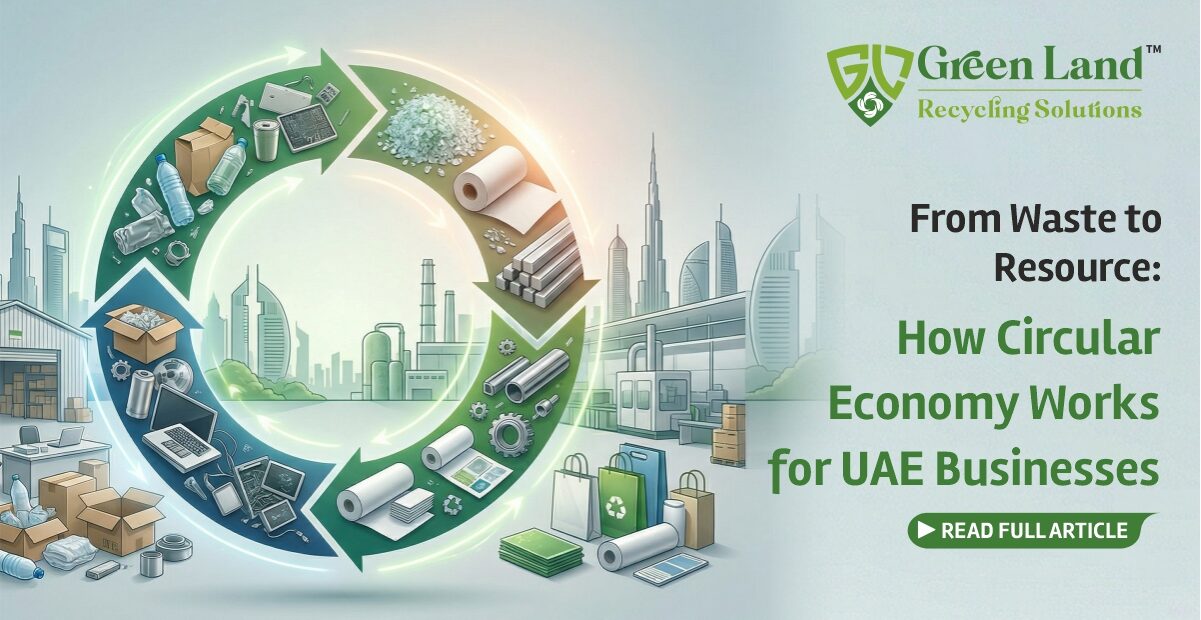
Step 1: Identify Waste Streams
Understand what materials your business generates — from packaging and plastics to e-waste and textiles.
Step 2: Segregate at Source
Separate materials into categories so they can be processed efficiently.
Step 3: Recycle and Recover Materials
Send materials to certified recycling facilities where they are converted into reusable raw materials.
Step 4: Reintroduce into the Supply Chain
Recycled materials are used again in manufacturing, reducing reliance on virgin resources.
This cycle continues — reducing waste and maximizing value.
Real Examples in UAE Businesses
Across industries in the UAE:
- Plastic waste is converted into flakes and reused in manufacturing
- Paper and cardboard are recycled into new packaging materials
- Metals are recovered and reintroduced into production cycles
- E-waste is processed to extract valuable components
These are not future concepts — they are already happening today.
How Green Land Recycling Solutions Supports Circular Economy
At Green Land Recycling Solutions, we help businesses move from disposal to circularity.
Our services include:
- Recycling of plastics, paper, metals, e-waste, textiles, and more
- Waste segregation planning
- Material recovery processes
- Compliance-ready documentation and reporting
We ensure that waste is not just removed — it is transformed into a resource.
The Future Is Circular
The transition to a circular economy is not just about sustainability — it is about smarter business.
Companies that adopt circular practices benefit from:
- Lower costs
- Better resource efficiency
- Stronger compliance
- Improved brand value
In the UAE, where sustainability is becoming a national priority, the circular economy is no longer optional — it is the future.
The Bottom Line
Waste is not the end of a product’s life.
It is the beginning of its next cycle.
With the right systems and the right partner, businesses can turn waste into value and build a more sustainable, efficient future. With Green Land Recycling Solutions, the journey from waste to resource becomes simple, structured, and impactful.