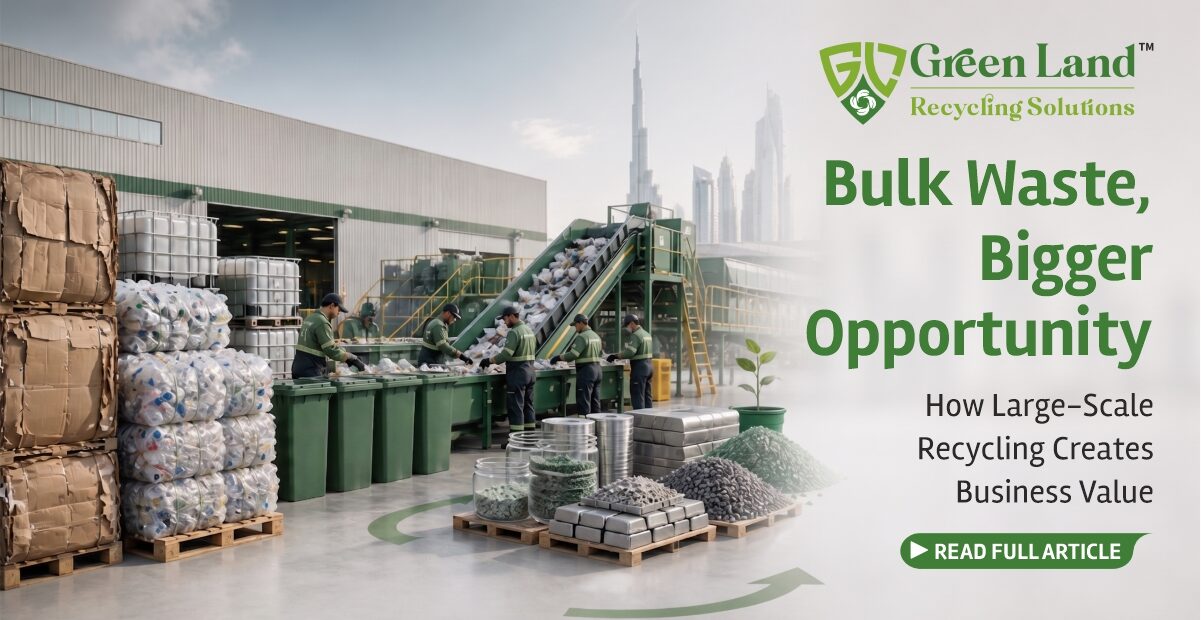
For many organisations, bulk waste is treated as an operational burden—something to remove quickly and at the lowest possible cost.
But in today’s ESG-driven business environment, that mindset is shifting.
Bulk waste is no longer just a disposal challenge. It’s a strategic opportunity to unlock value, improve efficiency, and strengthen sustainability performance.
The Scale Problem Most Businesses Overlook
Across the UAE, businesses generate large volumes of waste daily—retail, hospitality, manufacturing, logistics, and corporate sectors alike.
This includes excess inventory, packaging materials, e-waste, organic waste, and industrial by-products.
Without structured handling, this scale leads to rising costs, inefficiencies, and compliance exposure.
With the right systems in place, however, the same volume becomes an opportunity for optimisation.
This is where structured, end-to-end recycling solutions—like those implemented by Green Land Recycling Solutions—begin to shift outcomes.
From Disposal to Resource Management
The real transformation happens when waste is no longer treated as an endpoint.
Leading businesses are moving toward resource management models, where waste flows through a defined lifecycle—segregation, collection, processing, and recovery.
At scale, this requires more than ad-hoc vendors. It demands integrated systems, certified processes, and operational visibility.
By enabling this structured flow, Green Land Recycling Solutions helps businesses convert bulk waste into recoverable resources—efficiently and compliantly.
Where Large-Scale Recycling Creates Value
1. Cost Optimisation at Scale
Unstructured waste handling increases transportation, labour, and landfill costs.
Through streamlined collection and material recovery, businesses can significantly reduce these overheads.
With large volumes, even small process improvements—when managed through structured systems—translate into substantial cost efficiencies.
2. Stronger ESG Performance
Sustainability reporting is now a key business requirement.
Large-scale recycling enables organisations to track waste diversion, improve ESG metrics, and demonstrate measurable environmental impact.
With proper documentation and reporting frameworks, businesses can align more effectively with stakeholder expectations—something Green Land Recycling Solutions actively supports through its processes.
3. Compliance and Risk Reduction
Bulk waste often includes sensitive or regulated materials, particularly in e-waste and industrial streams.
Without certified handling, this creates exposure to regulatory penalties and reputational risks.
Structured recycling ensures traceability, secure processing, and adherence to environmental standards—providing businesses with confidence and compliance assurance.
4. Brand and Market Positioning
In competitive markets like the UAE, sustainability is no longer a side initiative—it’s a brand signal.
Businesses that manage bulk waste responsibly position themselves as forward-thinking, accountable, and aligned with global ESG expectations.
Reliable partners, such as Green Land Recycling Solutions, play a key role in enabling this consistency across operations.
5. Resource Efficiency and Circular Value
Bulk waste is rarely just waste. It often contains recoverable materials—metals, plastics, paper, and organic matter.
Through structured recycling processes, these materials are reintroduced into supply chains, supporting a circular economy model.
At scale, this shift transforms waste from a cost centre into a value-generating resource stream.
What High-Performing Businesses Are Doing Differently
Organisations that unlock value from bulk waste follow a disciplined approach:
- Segregating waste at source
- Implementing structured collection systems
- Partnering with certified recycling providers
- Tracking and reporting waste metrics
These are not one-time initiatives, but ongoing operational strategies—often enabled through experienced partners like Green Land Recycling Solutions.
The UAE Context: Why This Matters Now
With increasing emphasis on sustainability, ESG, and regulatory alignment, UAE businesses are under growing pressure to improve waste practices.
National initiatives aligned with Net Zero and circular economy frameworks are accelerating this shift.
In this environment, large-scale recycling is becoming a business necessity—not a choice.
From Burden to Business Value
Bulk waste will always exist.
The difference lies in how businesses choose to manage it.
Handled passively, it remains a cost.
Handled strategically, it becomes a source of efficiency, compliance, and long-term value.
The opportunity is clear:
The more waste you generate, the more value you can unlock—if you manage it right.